Introduction into the |
Science and Fun Spectroscopic Tools |
Step: 103
We want to regard a further example.
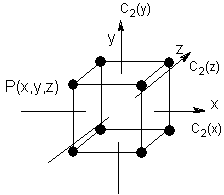
In a geometrical object (e.g. molecule), which we put into a cartesian coordinate system, the x and y axis are identical to ever a C2 axis of rotation. The coordinates of one point P (x, y, z) change with the stepwise made of the turning operations around the axes of rotation C2 (y) and to C2 (x) as follows = C2 (x) C2 (y):
C2 (y) C2 (x)
x, y, z ----- > x, y, z ----- > x, y, z
One obtains the same result as with the stepwise made of C2(y) and C2(x), if one made the symmetry operation C2 (z), i.e. a rotation of 180° around C2 (z) axis.
C2 (x) C2 (y) = C2 (z)
If the axes of proper rotation C2(x) and C2 (y) exist, thus also an axis of proper rotation C2 (z) must be available . We detect from the fact that the existence of certain symmetry elements causes certainly inevitably the existence of different symmetry elements. Further examples of it are:
If a Cn and a s v is available , then nsv ( e.g. BF3 in step 65 and C6H6 in step 68 ) must exist.
If a Cn and a perpendicular C2 is available, then nC2 (e.g. C6H6 in step 56 ) must exist.
Continue now to step 106 !